
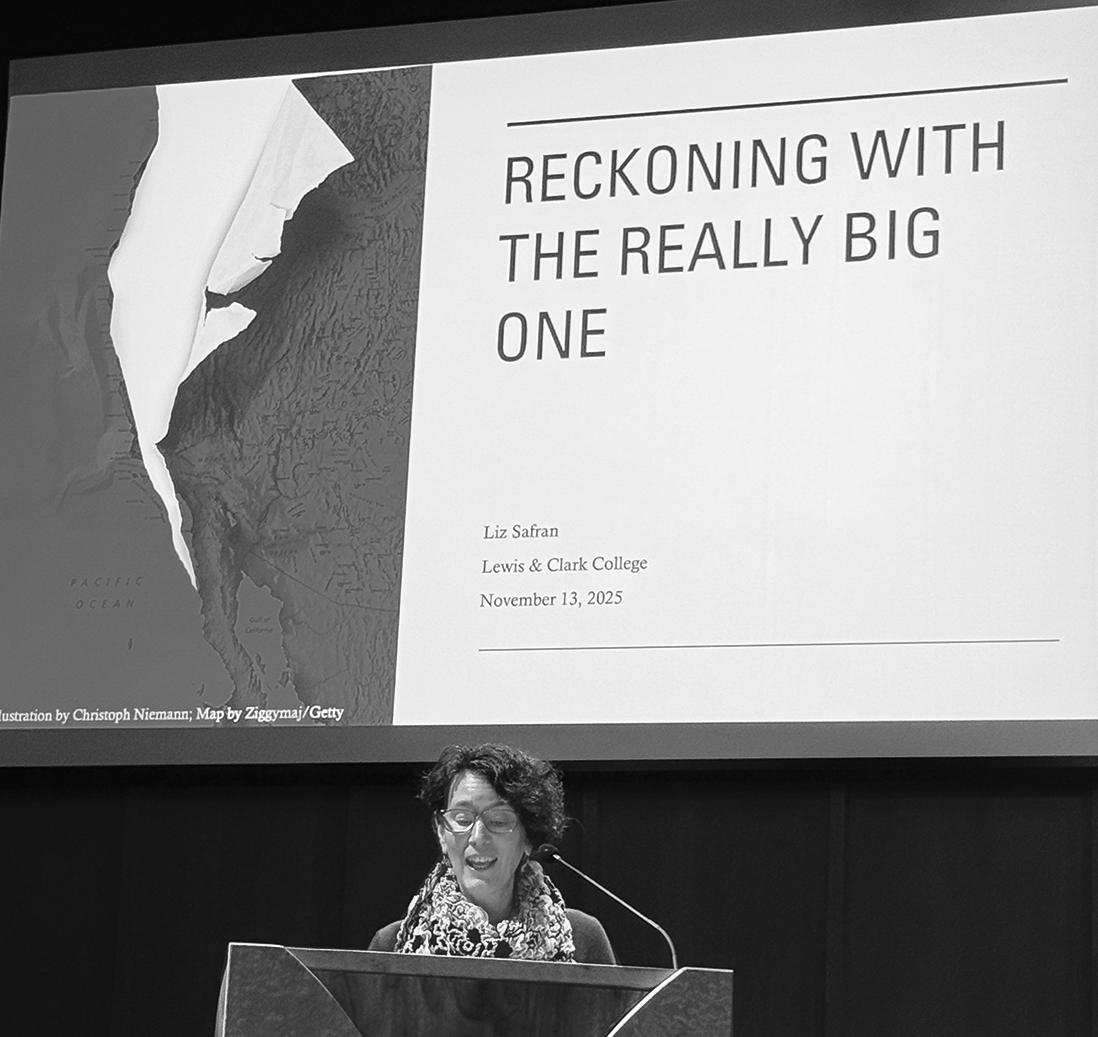
Dr. Liz Safran, associate professor at Lewis & Clark College, took her audience through a quick overview of Seismology and Plate Tectonics 101 to begin her presentation about a potential Cascadia Subduction Zone earthquake. The free BWNA-sponsored November Speaker’s Forum event, “Reckoning with the Really Big One,” attracted more than 100 attendees.
Safran explained that while the science of seismology is only a little over 60 years old, through meticulous analytical work on tsunamis and detailed record keeping in Japan, it was determined that the last major earthquake in the Pacific Northwest occurred 325 years ago. In addition, by investigating unique signals and tell-tale signs in the strata of sea floor channels along the Washington and Oregon coasts, geologists have been able to piece together a 10,000-year timeline of major quakes along the interface of the North American and Juan De Fuca tectonic plates — otherwise known as the Cascadia Subduction Zone.
“We’re not all going to die, but it’s going to suck.”
While geologists can’t pinpoint exactly when the next BIG earthquake will occur, they can use historical data to predict that one is due to occur. The only warning within existing scientific capabilities is in terms of seconds — enough to drop, cover, and hang on.
This is where Dr. Safran’s presentation pivoted from academics to real life impacts. Tsunamis along the coast and urban shaking and soil liquefaction in the metro area will have the biggest impacts, causing destruction of the infrastructure. Steps are being taken to mitigate damage, including plans for a new “earthquake-ready” Burnside Bridge, construction of earthquake-resistant runways at PDX, and legislation of fuel storage standards to name a few. However, there will be no electricity, no water, no passable roads, and first responders cannot be counted on for a minimum of two weeks.
“We’re not all going to die, but it’s going to suck,” Safran announced to a rapt crowd. She said people need to be prepared to depend on close neighbors for weeks or months. She encouraged folks to develop relationships with their neighbors, discuss and coordinate emergency supplies, and build in local resiliency that will be required when the “Big One” does occur.
Check out the Portland Bureau of Emergency Management at portland.gov/pbem for links to many useful sites that aim to help neighborhoods prepare for emergencies.
John Sandie relocated from the Midwest with his wife Kathy to be closer to children and grandchildren in the area, landing on Fremont Street in B-W in early 2011. In retirement they pursue their desires to make a difference locally, John by volunteering with the neighborhood association, Kathy with Alameda School. The duo is contentedly busy volunteering and keeping up with grandchildren.